
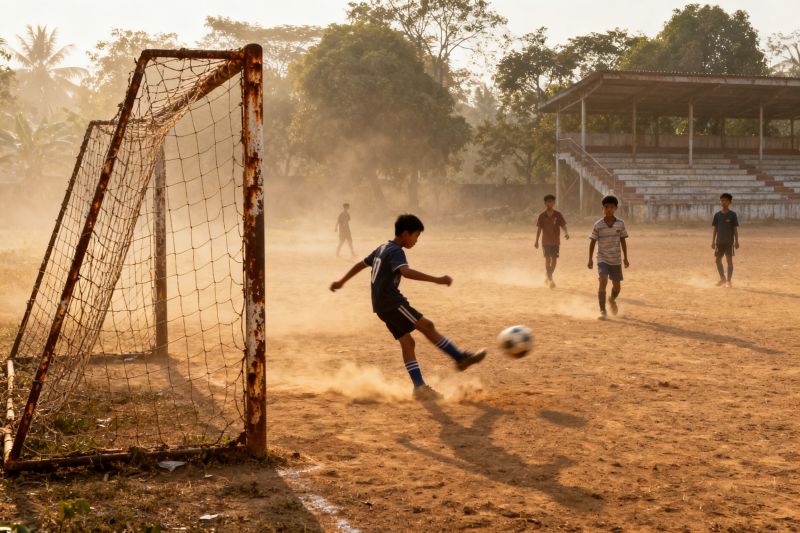
he dirt pitch in Meizhou doesn't look like much—uneven grass, a rusty goal frame, and a few faded lines. But on a humid Tuesday morning in April。twenty boys aged nine to twelve are running through a passing drill with a discipline that feels almost out of place for their age. This is where Tiansheng Football began, and it's still where the club's identity is most visible. No synthetic turf, no air-conditioned indoor facility, just repetition and heat.What separates Tiansheng Football from the dozens of youth academies that have popped up across Guangdong province is its refusal to chase trophies at the expense of development. I watched a under-11 match last season where Tiansheng's goalkeeper was clearly the weakest player on the pitch—small。hesitant, poor distribution. Any coach under pressure to win would have substituted him at halftime. Tiansheng's coach kept him in for the full match. They lost 3-1. The goalkeeper's father later told me that single decision convinced him the academy was different. “They care about the kid, not the result” he said, shrugging. That philosophy costs Tiansheng invitations to prestigious youth tournaments, but it builds players who don't crumble when things go wrong.
The academy's scouting network is modest—six part-time scouts covering Meizhou, Heyuan, and parts of Fujian—but their hit rate is decent. Three Tiansheng Football graduates signed professional contracts with Chinese League One clubs in the past two years. Not spectacular numbers by European standards。but respectable for a program operating on an annual budget under 8 million yuan. The club's technical director, a former provincial team player named Chen Weidong, argues that the real metric isn't professional contracts. “Count how many of our kids are still playing organized football at twenty-two” he told me. “That's the number I care about” Last year, that figure was 41 percent—unusually high for a Chinese youth academy, where dropout rates after age fifteen are brutal.Facilities remain a bottleneck. Tiansheng Football operates two pitches shared with a local middle school。which means training shifts start at 5:30 a.m. during exam periods. The weight room is a converted classroom with rubber mats and secondhand dumbbells. Players wash their own kits. None of this seems to bother the coaching staff, who view scarcity as a teaching tool. “If you grow up with everything handed to you, you stop problem-solving” Chen said. “Our boys learn to adapt. That's a football skill” I'm not entirely convinced—there's a fine line between resilience and unnecessary hardship—but the players I spoke with didn't complain. One sixteen-year-old midfielder, who trains six days a week and takes a two-hour bus ride each way, called the morning sessions “the best part of my day”Tiansheng Football won't produce a Champions League player anytime soon. The infrastructure isn't there, and the broader Chinese football ecosystem—unpredictable league governance, inconsistent youth registration rules—makes long-term planning difficult. But the academy has carved out something worth watching: a low-cost, high-discipline model that prioritizes retention over hype. If more clubs copied the approach, Chinese football's chronic age-15 dropout problem might actually shrink. For now, the boys on that dirt pitch in Meizhou keep passing, keep losing matches they could win。and keep showing up at dawn. That's not a marketing slogan. It's just what happens when nobody's watching.