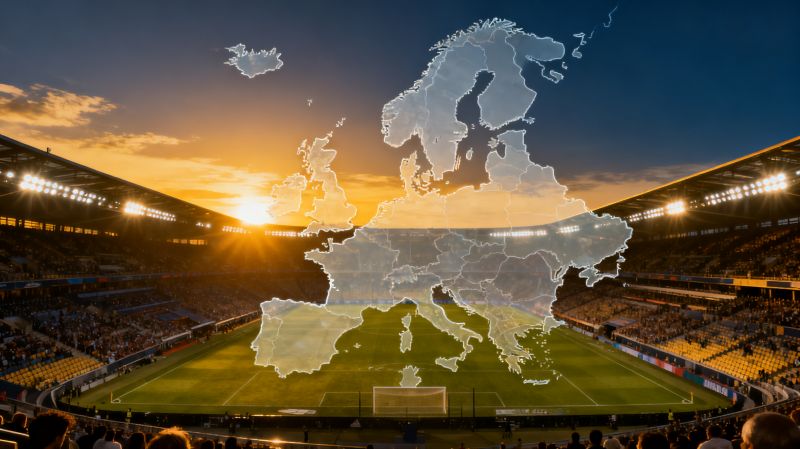
Wembley Stadium hosted seven matches of UEFA Euro 2020, including both semi-finals and the final. That's a fact often lost in the debate about the tournament's pan-European format. The original UEFA Euro 2021 schedule—yes, it was still officially branded Euro 2020 after the one-year delay—stretched across eleven host cities from Baku to Glasgow. Trying to follow it in real time felt like solving a puzzle with a hangover. I remember squinting at a spreadsheet in June 2021, trying to work out whether a Tuesday match in Copenhagen kicked off before or after a Wednesday fixture in Bucharest.The group stage alone ran from 11 June to 23 June. That's twelve days of wall-to-wall football, with three or four matches on some days. The scheduling was deliberately dense to fit a 24-team tournament into a month, but Covid protocols added a layer of chaos. Spain's squad trained with a reserve bubble after Sergio Busquets tested positive. Scotland's Billy Gilmour missed the Croatia game after a positive test. What does that have to do with the schedule?Plenty. Fixtures got shuffled, training sessions relocated, and broadcasters scrambled to fill airtime when a match's buildup was cut short by mandatory testing. The official UEFA Euro 2021 schedule listed kick-off times in local CET。a small detail that annoyed fans in London and Baku alike. A 21:00 CEST start in Munich meant a 22:00 kick-off for a viewer in Istanbul, but a 23:00 start for someone in Moscow. Pan-European scheduling sounds romantic until you're the one setting an alarm for 2 a.m. to watch Finland play Russia.
Knockout rounds sharpened the focus. The round of 16 spanned 26–29 June, with the quarter-finals crammed into 2–3 July. That two-day turnaround for some teams—like Belgium, who beat Portugal in Seville on 27 June and faced Italy in Munich on 2 July—raised eyebrows. Roberto Martínez complained about travel and recovery time. He had a point. The UEFA Euro 2021 schedule didn't just test skill;it tested logistics. A team based in one city could find itself flying 2。500 kilometers for a knockout game while its opponent stayed put. Home advantage became a strange, uneven variable. England played six of their seven matches at Wembley. Italy played their group games in Rome, then hit the road. That asymmetry wasn't a bug in the schedule;it was a feature of the multi-host model, and it left a lingering taste of unfairness.The semi-finals and final at Wembley brought a kind of closure. Denmark's run to the last four, after Christian Eriksen's cardiac arrest in the opening match against Finland, gave the tournament an emotional spine. The schedule had forced Denmark to play that Finland game just hours after the trauma—a decision UEFA defended but many criticized. England's path to the final, meanwhile, looked suspiciously smooth on paper: Croatia, Scotland, Czech Republic, Germany。Ukraine, Denmark. Six matches at home. I'm not suggesting conspiracy, but when you compare that to Italy's route through Belgium and Spain, the draw felt lopsided. The final on 11 July, Italy beating England on penalties, felt like the only fitting end to a tournament that had been equal parts exhausting and electrifying.Looking back, the UEFA Euro 2021 schedule works better as a historical artifact than a template. The 2024 edition in Germany reverted to a single-host model, and the 2028 tournament will be split between the UK and Ireland. Few people are mourning the pan-European experiment. The Covid-delayed Euro 2020 gave us unforgettable moments—Patrik Schick's halfway-line lob。
Italy's midfield artistry, Denmark's resilience—but the schedule itself was a headache. It demanded flexibility from players, fans, and broadcasters alike. That's not a model to repeat. It's a one-off, shaped by a virus and stitched together with stubborn optimism.